
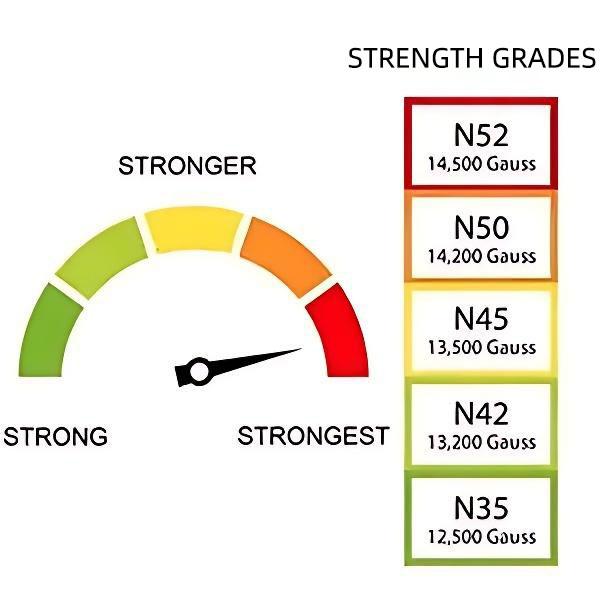
Have you ever thought that magnets, those magical little things that make motors run fast and electronics small yet powerful, actually have different ‘strength’ levels? Today, let’s talk about N35 and N52 magnets and see who is stronger.
What are N35 and N52 magnets?
N35 and N52 magnets are sintered NdFeB magnets. They are like ‘close relatives’ in the magnet world, with similar ‘family genes’ – the same level of intrinsic coercivity Hcj, which is higher than 12 kOe (CGS unit) or 955 kA/m (SI units). Simply put, they have about the same resistance to ‘loss of magnetism’. 1 kA/m = 12.566 Oe, 1 kOe = 79.577 kA/m.
However, their maximum BH values are very different, from about 35 MGOe for N35 to 52 MGOe for N52. This difference means that the N52 magnets are about 49% more magnetic than N35. This difference means that the N52 magnet has about 49% more magnetic energy than the N35. If you compare the magnet to an engine, the N52 is a more powerful ‘turbocharged’ version of the magnet, which allows the motor or device to perform more powerfully, but also to be smaller and lighter.
II. What is the difference between N35 and N52?
(i) Why is the (BH) max so different?
Some people may wonder if this is a quality problem. Actually, it is not at all. The classification of permanent magnets only depends on the magnetic properties, and is not directly related to the quality. Different grades are achieved by adjusting the material composition and microstructure, just like mixing different ‘magnetic recipes’.
(ii) Cost and Application
Although N52 magnets are very powerful (currently at the top of the commercial magnet class), they are also costly, about 50% more expensive than N35 magnets. Therefore, N35 magnets are more common in cost-sensitive applications. Compared to other permanent magnets, such as ceramic or ferrite magnets, N35 magnets are almost 8 – 9 times more powerful. In some cases, magnets such as N45, N48 and N50 can also be used in place of N52 by optimising the design to achieve the target performance at a lower cost.
Specific parameters of N35 and N52 magnets
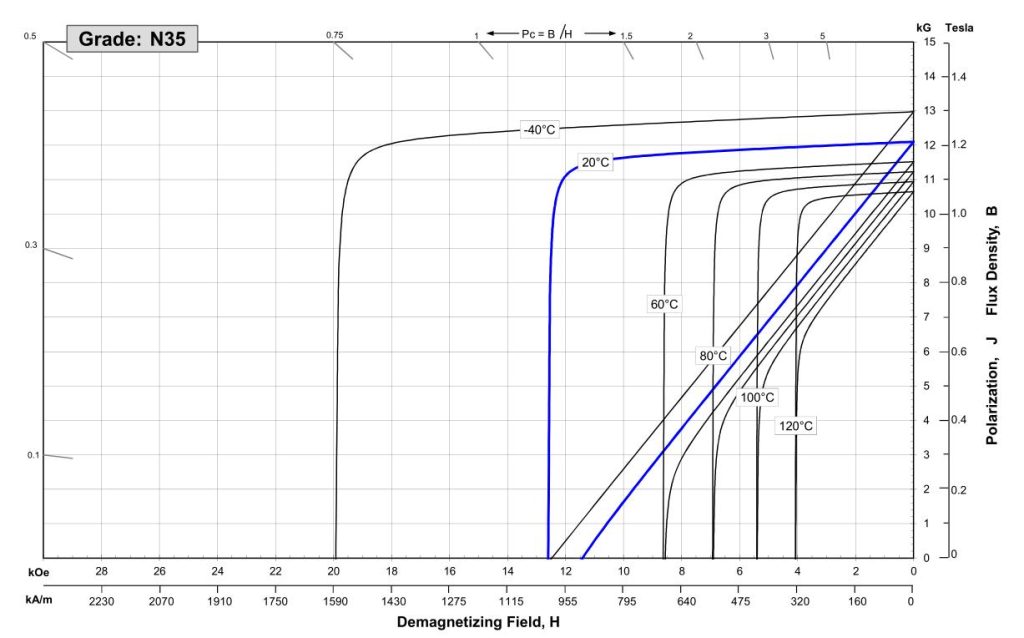
(i) N35 Grade Sintered Neodymium-Iron-Boron Magnets Magnetic Properties
| Characteristic | Units | min. | nominal | max. |
| Br , Residual Induction | Gauss | 11,700 | 12,100 | 12,500 |
| H cB , Coercivity | kA/m | 860 | 907 | 955 |
| BHmax , Maximum Energy Product | MGOe | 33 | 36 | 38 |
| kJ/m 3 | 263 | 283 | 302 |
Demagnetisation Curves
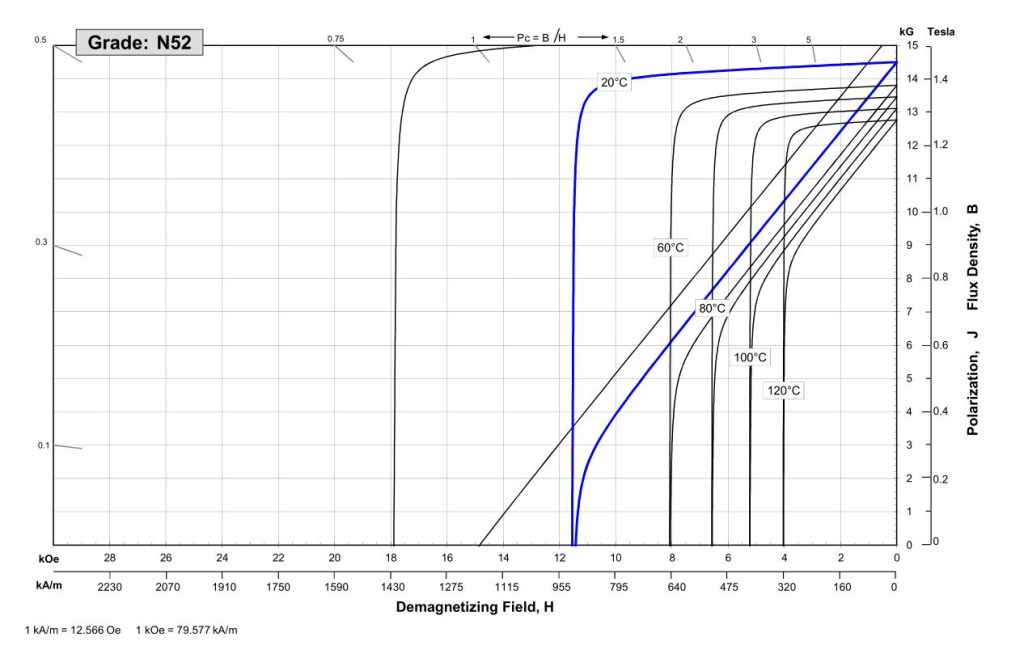
(ii) N52 Grade Sintered Neodymium-Iron-Boron Magnets Magnetic Properties
| Characteristic | Units | min. | nominal | max. |
| Br , Residual Induction | Gauss | 14,200 | 14,500 | 14,800 |
| H cB , Coercivity | kA/m | 836 | 979 | 1122 |
| BHmax , Maximum Energy Product | MGOe | 49 | 51 | 53 |
| kJ/m 3 | 390 | 406 | 422 |
Demagnetisation Curves
Summary
Rare earth magnets of N52 grade are more powerful than those of N35 grade of the same size, professionally designed and finely crafted with tight tolerances and powerful performance. However, the exact choice of magnet depends on the application scenario and cost budget. I hope this knowledge gives you a clear understanding of N35 and N52 magnets!