

How do magnets work? From micro to macro magical power
1. The basic components of a magnet
Magnets are very common in our lives, whether on a simple fridge sticker or in complex industrial automation equipment, it plays an important role. So, how exactly do magnets work? Today, let us together in-depth exploration of the working principle of magnets, from the microscopic atomic structure to the macroscopic phenomenon of magnetic fields, to unveil the scientific mystery behind the magnet.
Magnets are made of specific materials that have a unique atomic structure that produces a magnetic field. Common magnetic materials include transition metals such as iron, cobalt, nickel, and certain alloys of them.
At the atomic level, the special properties of magnets come from the arrangement of electrons within their atoms. Not only do the electrons rotate around the nucleus, they also rotate on their own axis, a rotation known as spin. The spin of each electron creates a tiny magnetic field. In most materials, the direction of the electron spins is haphazard and the magnetic fields they produce cancel each other out, so these materials are not magnetic overall. However, in magnetic materials, the electronic structure of atoms enables the spin directions of certain electrons to be neatly aligned, and their magnetic fields superimpose on each other, thus forming a macroscopic magnetic field, which is the fundamental reason why magnets are able to generate magnetic fields.
2. the generation and distribution of magnetic field
When the electronic spin in the magnetic material is arranged in an orderly manner, a magnetic field is generated around the material. Magnetic field is a special form of material existence, it has the direction and size, can be described by the magnetic field strength.
The distribution of the magnetic field of a magnet follows a certain pattern. In the case of a common bar magnet, for example, the magnet is most magnetic at the two ends of the magnet, and these two regions are known as the magnetic poles, which are the North (N) and South (S) poles. The area between the poles is relatively weakly magnetic. A magnetic field line is a closed curve that starts at the north pole, travels through the interior of the magnet, and returns to the south pole. The sparseness of the magnetic field lines represents the strength of the magnetic field: the denser the lines, the stronger the field.
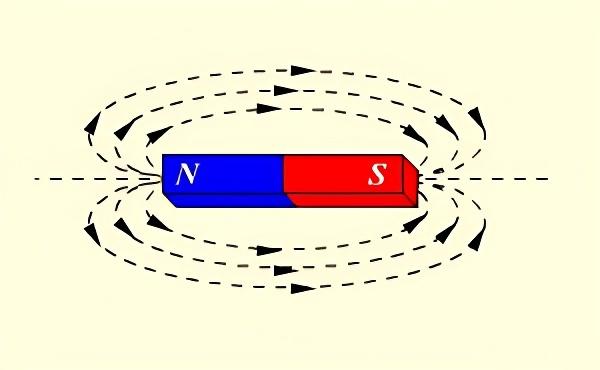
Magnetic fields are directional, with identical poles repelling each other and different poles attracting each other. This force of interaction between magnetic poles is the reason why magnets can attract or repel other magnetic objects.
3. Classification and Characteristics of Magnets
According to the magnetic source and magnetic field properties of magnets, magnets are mainly divided into two categories: permanent magnets and soft magnets.
Once a permanent magnet is magnetised, it can remain magnetic for a longer period of time. Common permanent magnet materials are NdFeB and ferrite. Permanent magnets have stable magnetism and are not easily affected by the external environment, so they are widely used in industrial automation equipment, electric motors, generators and many other fields.
Soft magnets, on the other hand, are different from permanent magnets in that they are easily magnetised and lose their magnetic properties. Common soft magnetic materials include ferrosilicon alloys and pozzolanic alloys. Soft magnets have high permeability and are easily magnetised, but when the external magnetic field disappears, their magnetism also disappears quickly. Soft magnets are commonly used in transformers, electromagnets and other equipment that require rapid magnetisation and demagnetisation.
4. Application of magnets
The magical power of magnets has a wide range of applications in many fields.
In the field of new energy, magnets play a key role. In wind power generation, powerful magnets are used to make the core components of permanent magnet motors, such as the rotors of generators and electric motors, to improve energy efficiency and reduce maintenance costs. According to the International Renewable Energy Agency (IRENA), global installed wind power capacity is expected to nearly double from current levels to 680GW by 2025, increasing demand for powerful magnets. In new energy vehicles, high-performance magnets such as neodymium-iron-boron (NdFeB) magnets are widely used in drive motors to improve the energy efficiency and performance of vehicles. In addition, in the field of solar photovoltaic, magnets are also used for precision cutting and assembly of high-efficiency panels.
In the field of robotics, the application of magnets is also becoming more and more widespread. The development of micro-robots and neodymium magnets has opened up new possibilities for robotic applications in the medical and industrial fields. For example, using neodymium magnets, Ecoflex and soft films, scientists have invented a soft-magnetic micro-robot capable of multiple movement patterns. This robot can control its movement, grasp and transport tiny objects by manipulating the parameters of an external magnetic field, promising applications in stomach examinations. In addition, magnets are used in joint encoders and high-precision sensors in industrial robots to provide precise position and velocity feedback for more efficient automated operations.
Magnets are essential components in electronic devices. For example, magnetic heads in computer hard discs use the magnetic field of magnets to read and write data; magnets in loudspeakers and headphones convert electrical signals into acoustic signals; and vibration motors in mobile phones rely on the magnetic field of magnets to produce vibrations.
In the field of electrical systems, magnets are commonly used in power generation and transmission processes. The rotor of a generator is usually made of magnets, whose magnetic field induces an electric current in the stator coils as the rotor spins, thus converting mechanical energy into electrical energy. The core of a transformer is made of a soft magnetic material that efficiently transmits and converts electrical energy.
Magnets also have important applications in the medical field. Magnetic Resonance Imaging (MRI) is a medical imaging technique that uses a strong magnetic field and radiofrequency pulses to generate images of the body’s internal structures. Through MRI, doctors can clearly observe the organs, tissues and blood vessels inside the human body, thus providing an important basis for the diagnosis and treatment of diseases.
In industrial production, magnets are used in various automated equipment and mechanical devices. For example, electromagnets can be used to control mechanical movements, sort metal materials, and transport materials. Magnetic materials can also be used to manufacture a variety of sensors and actuators to achieve the detection and control of physical quantities.
5. the future development trend of magnets
With the continuous progress of science and technology, the research and application of magnets are also continuing to develop. Scientists are working hard to develop new magnetic materials to enhance the performance and application of magnets.
For example, high-temperature superconducting magnet is a kind of magnet that can still maintain superconductivity at relatively high temperatures, which has many advantages such as zero resistance, high magnetic field strength, etc. It has a broad application prospect in the fields of magnetic levitation trains and nuclear fusion reactors. In addition, nanomagnetic materials is also a research hotspot, it has a small size effect, quantum tunneling effect and other unique properties, is expected to achieve new breakthroughs in biomedicine, information technology and other fields.
In conclusion, the working principle of magnets involves atomic physics, electromagnetism and other disciplines, and its application has penetrated into every aspect of our life. Through in-depth research and continuous innovation of magnets, we will be able to make better use of this amazing power and make greater contributions to the development and progress of mankind.
The electron spin mentioned in How Magnets Work is a fundamental quantum mechanical property of electrons. Although the name has ‘spin’, it is not a classical physical rotation like the rotation of the earth, but an inherent endowment of electrons (similar to charge or mass), which can be simply understood as a kind of ‘intrinsic angular momentum’.